Saturday, July 16, 2011

Moving and Adapting to Change

Moving is a big deal.  It requires meticulous planning, thoughtful organizing, the actual moving itself, setting everything back up and then finally, adapting to your new home.  I think that in general people have the hardest time with the last step but, when it comes down to it, it is the most important of them all.
Things will not be the same after a move; the corner store will host peculiar faces, the air will smell unusual and the sky will take on new shades of colors.  Your days will begin differently, as the sun will wake you at abnormal angles and they will end oddly while your eyelids grow heaving staring at an unfamiliar ceiling.  If you let all the idiosyncrasies get to you and dwell on them they will turn against you.  This is where the final step of adapting comes in to save the day.
Humans have been adapting to their environments for as long as we have walked the planet.  From cavemen to farmers and Englishmen to pilgrims, no other species on the earth can adapt as well as we can.  Adapting, in short, is just accepting that things are not going to be the same and moving forward from there.
Moving to a new country though is a bit different from a move down the street.  The language is at first a challenge, the money feels weird and requires more math than should be necessary to buy lunch and the clocks run on what we refer to in America as military time.  I still have a hard time answering requests for the time when it is past noon. 
Here is a rundown of some of the things that I found new and strange upon coming to Brazil.  Some are kind of neat and some pretty out there but, there is an interesting allure to their unusualness that makes moving to any foreign country entirely remarkable.

Tap Water
Let us go ahead and start with the tap water.  The tap is not your friend here.  Unless you are boiling it for a soup or to make coffee in the morning, tap water is not to be digested.  This basic practice is something you want to look out for in all third world countries.  Brazil is not the worst of them that I have been in though; in Cambodia I brought a bottled water to brush my teeth and rinse my tooth brush with.  Brushing your teeth flies here but that is where the line is drawn.  About once a week our house goes through a water jug that we call the city to replace for R$5.  Not a bad price to pay to keep yourself off the toilet for a week.   
                Also, the tap has no western water heater attached to it.  So, you have cooked an amazing meal with your roommates.  The group of you has stuffed yourselves with rice, beans, pork and gotten a little rowdy over some beers.  The time eventually comes to clean up the pile of pots and pans you have thrown aside in the mad dash to the table.  You stumble over to the sink, dip your sponge into the stream to get to scrubbing and are rudely shocked into soberness.  The water is like ice and no matter how long you wait for it to get warm, that temperature is not going to budge a degree. 
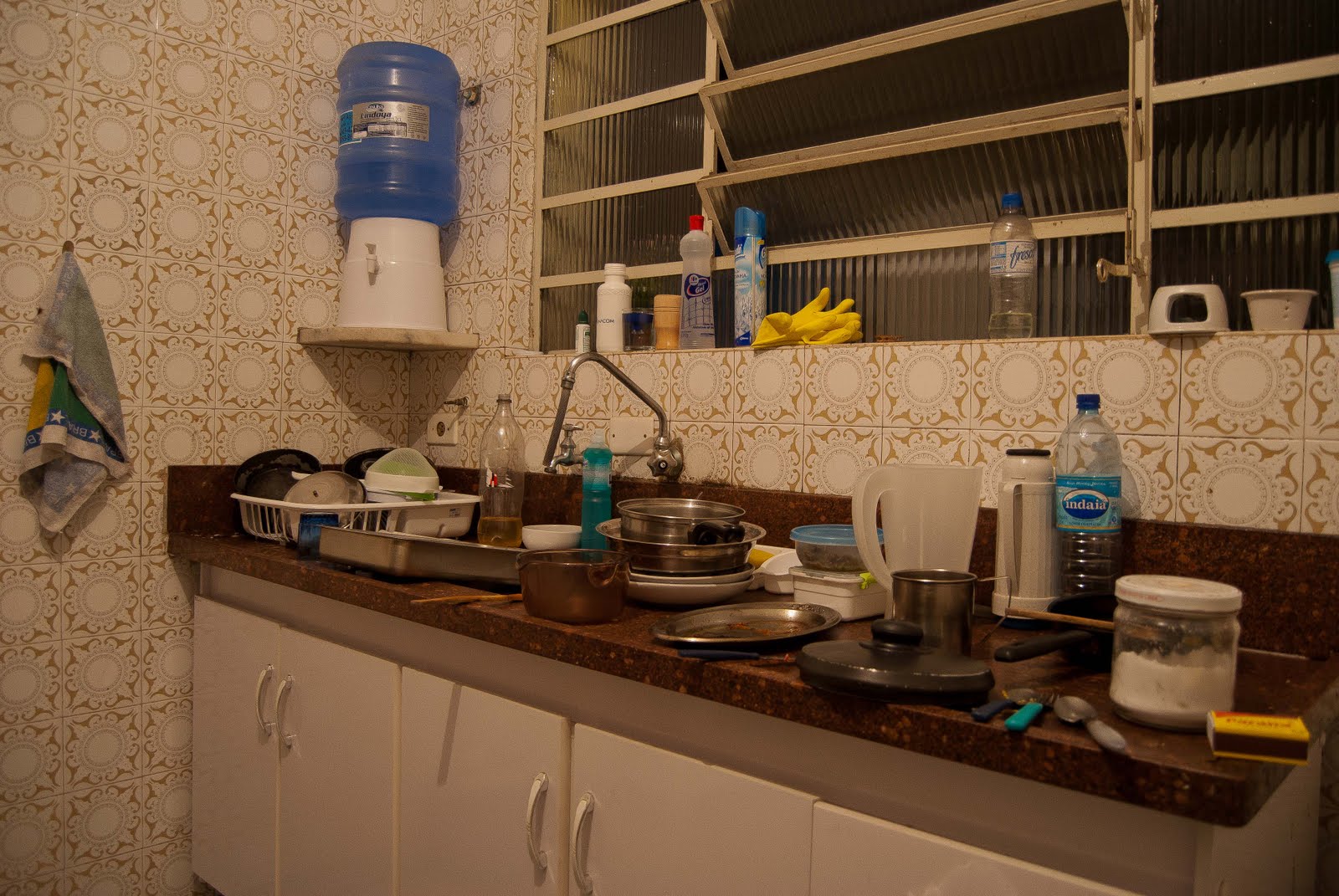
There is a perfectly acceptable reason why these dishes are not done.

Winter During Summer
                I knew that it was going to be winter while I was here.  It is one thing though to know something and then an entirely different experience to live it.  While the people of the northern hemisphere enjoy beaches and tans, I went out and bought a new jacket to battle the cold.  Even while in Brazil, it can get mighty chilly and I am not much of a packer when it comes to travel; the lighter the better as I am usually on the go.  The house I am staying in does not help much either.  It is designed with loose fitting windows, tiled floors and mortared walls; not the best to insulate heat.  Central heating is also not a translatable phrase because it simply does not exist. 
All my belongings for four months, not much room for winter clothes.
Daytime is not so bad while the sun is out and shining.  Average temperatures can run up to 70 degrees Fahrenheit and with a nice breeze are rather pleasant.  Gloomier, cloudy days can dip into the upper 40s though.  As the sun’s glow turns from yellow to red and sets behind the skyscrapers to signal the coming of night, temperatures plunge into the 40s.  A trip to the market or pizza joint down the road occasionally requires my thickest socks.  I can deal with it for the most part but even while it is 65 F. out, the Brazilians still look miserable in their mittens and caps. 
And oh yeah, sunset is at five o’clock.     

Learn to Love Football
                South American countries love soccer and Brazil is no exception.  On at all times of the day, live or reruns, football is the sport of the country.  Being summer back in the states and missing out on all the baseball is tough for me but, football is not all bad.  The rules to the game are simple enough at least, I just wish there was more action and less whining.  I am not trying to take anything away from the world’s sport; it is most certainly enjoyable after a few beers.  Although, when stalling for time is an integral part of a team’s strategy and looking for penalty handouts occur on the regular…ugh, gag me with a goal post.  Thank god for www.MLB.com's daily free game that I can stream from time to time to get my fix. 
                Despite my complaints, I am looking forward to attending a live match.  Every sport is better live. 

Toilet Bins
                I saved this one for last as I would not expect many people to continue reading the blog if I had made it the first on the list.  In the western world, where most of the people who read this blog hail from, we have been taught after going to the bathroom you throw your dirty paper in the toilet.  Do your best to forget that notion here, it goes in a trash bin beside the toilet.  The reason for this is because the pipes and plumbing here are old, skinny and prone to backups.  At this point it would be way to costly to change the way things are done and already made.  Most western travelers find this most difficult to deal with, as public bathrooms now have another reason to be avoided tacked onto them. 
I'll spare you the toilet bin and show you how every shower has a squeegee instead.
                If you cannot deal with this, rent a room at the Hilton or Marriot for a couple hundred Reals a night; they have western plumbing.  Secretly though, and hopefully my roommates miss this post, I flush mine at home…

                And there are some of the few things that take some getting used to in Brazil.  Granted, those oddities are surely to be found in other places around the globe and the list is but the tip of a long, long catalog of culture shocks.  But that is just the way it is here and fighting against the change will only make one miserable.  It is best to accept and adapt to the changes if one is to enjoy himself/herself in a new and alien place.  In each new shock that comes along there is something to be said about a country and its people, even a beauty to them can be seen once accepted; well, maybe not the toilet bins.

Wednesday, July 13, 2011

Mercado Municipal


The main entry way
                From a block away the constant flood of people moving in and out of the building grabbed my attention.  Shuffling out from under a striking archway topped with stained glass windows, people teetered like penguins as they carried their loaded bags of groceries and culinary supplies.  As I made way through the masses into the Mercado Municipal, Sao Paulo’s largest food market, my dormant love of food began to awaken.  Everywhere I glanced, my eyes feasted on the food displays extending before me.  Fresh, colorful produce rested in crates, international wines were stocked high upon shelves and drying salami hung from hooks above shopper’s heads.  I had to be careful not to let others see me begin to salivate as I caught a whiff of a spice aisle, the combination of herbs and spices forming recipes in my head.       
                The 12,600 square meter market place is home to over 290 individual shops and employs over 1,500 people, according to the markets website.  Many of the shops seemed to be closed up though dulling such statistics a bit.  After giving the market a thorough walk around the number of shops open was more akin to around 200; still an impressive number.  The Mercado Municipal website also claims that the market handles approximately 450 tons of food per day, this I can believe. 
There are not many things that I love more about traveling than visiting such a place.  Whether the market is artisan or food, outdoors or indoor or a combination of all the above; they are locations that denote a simpler, gentler life.  Unlike the aisle ways of westernized grocery stores where people begrudgingly steer their steel shopping carts, loading them with boxes of cereal and packaged meat, open markets seethe with life.  Markets are not only for getting some basic shopping done but are personal places for people to interact and be part of a community. 
As I strolled through the Mercado Municipal, occasionally stopping to sift through the piles of diverse produce, I focused on the chatter of shoppers around me.  Even with a loose understanding of the Portuguese language I could grasp the other patrons negotiating and bargaining over cuts of meats and the weight of produce.  A short older woman looking happy with the purchase of a bag of salted olives and the banter of a butcher with a middle aged gentleman holding a half empty bottle of beer brought a chuckle to my chest.  Sights like these are rare and few in the canned food aisle at the grocery stores back home.    
A view from the second floor, many bars and restaurants line the larger aisles and second floor
The Mercado Municipal is also a much more elegantly designed building than that of your run of the mill grocery stores.  It was designed by Francisco Ramos de Azevedo in 1926 and was opened in January of 1933.  Lighting is dim and mostly natural, seeping through the grand elongated skylight above and the stain glassed windows rowing the walls on all four sides.  In total there are 72 stain glassed windows divided among 32 panels designed by a Russian artist Conrad Filho.  Filho is famous for his work on Sao Paulo’s Cathedral da Se and 300 other churches across the country.  When clouds pass overhead they play tricks with the shadows and give the impression of a constantly changing environment.
Cheese, Brazilians love cheese
After gawking amid the fine fare, I decided it was my duty as a former culinary arts student to buy some cheese, salami and a bottle of wine; it only seemed appropriate.  I began to prowl through shops more carefully, picking up cheeses to examine their firmness, carefully sniffing them to determine their sharpness as I struggled to read their labels.  After a few shops I came across one that had a good selection of products that matched my opulent criteria.  I asked for a sample and the vendor sliced off a healthy portion right off the block I held in my hand.  It was a softer cheese but retained its shape as I bit into it and had a gentle, smooth finish.  The bottle of wine I was not as picky on and snatched a bottle of Chilean Cabernet from the same store; drinking a European or Californian brand seems pretentious in South America. 
And good meat is not hard to come by
I began my hunt again in search of a few spicy links of salami.  Once again I desired something that was going to retain its shape and not break down while I chewed it.  I approached a butcher’s stand where the salami hung above salted tongue and pigs feet; both delicacies I was not feeling like taking on at the moment.  I sniffed and poked at the links and selected a few that had the texture of beef jerky but still had some leeway when I subtly pinched them.  A short woman reached up with her butcher’s knife and sliced them down for me as I pushed in-between another set of links to hand the cashier my money. 
Now impatient to eat my carefully chosen meal I began to scurry towards the door, joining the other teetering patrons in their scuffle to do the same.  As I made my way down the aisle I noted several juice stands, sandwich shops and bars beckoning me to come spend more of my cash.  I took note and thought to myself that another trip is definitely in store for this market; that is for sure. 

Thursday, June 30, 2011

Gypsies of Minas Gerais

I have heard it said that wealth is the supreme source of all happiness.  That one cannot be pleased with their life if they do not possess money in their bank account and cash in their wallet.  As Rodrigo and I carefully walked towards the shoddy tents and the laughing children, playing with their torn kites in the afternoon breeze, I could not disagree more with that statement.  These people we were approaching clearly had nothing yet the sound of thoughtless laughter filled the air. When we began to skirt the parameters of the camp, a few people, their hair in tangled messes with dirt smearing their faces, began to poke their heads out from under their tent’s frayed flaps to eye my translator and I.  The children moved a little closer to us, revealing tattooed hands and wary expressions.  I felt bad for Rodrigo; he had listened to all the horror stories of the gypsies as I had the days before and must have been as apprehensive as I was approaching these peculiar people.  “Don’t have anything in your pockets.” “You have to be cleverer than them.” “Are you really taking your camera?”  Bet your ass I was taking my camera. 
The gypsy band first caught my eye when I was receiving a tour of Pouso Alegre, Menas Gerias, although it was not the people who initially grabbed my attention.  It was their clothes hanging dispassionately on a thin rope underneath a beaten up billboard right beside the road; an old woman tending to a pair of socks as speeding cars kicked up dirt and gravel only feet away from her.  I inquired to who they were and was greeted by laughs. “Those are the gypsies,” my guides informed me.  Immediately intrigued, I wanted to know more about them and made it my business to go down to their field and speak with them.  I fell asleep that night wondering, “What makes someone want to live in tattered tents with no running water or electricity?”  A few days later I found myself frantically thinking of ways to explain my inquisitiveness whilst stepping closer and closer to their encampment; hoping that they would be receptive to me. 
Maria the gypsy leader, Age 59
As Rodrigo and I tip-toed around half eaten fruit and discarded clothing, we asked one adolescent girl where we could find the leader, or someone to speak with about what they were doing there.  She led us into the encampment and searched around for the chief, a woman named Maria.  The encampment was not very large and we shortly arrived at a dirt stained yellow tent, the muddy floor carpeted by two sheet less mattresses with their stuffing coming out.  Maria was there with another woman who was holding a tiny child no more than two years old.  They must not get many visitors for they were as hesitant to speak with us as we were with them.  We explained we were just curious people who wanted to know more about what they were doing in a field away from the rest of the city and people.  I played the, “I am an American,” card and their wariness took a back seat to curiosity.  It is good to know that one still works once in a while for the better.
Maria, the chief by age, told us how she had been a gypsy for all of her 59 years; nomadically moving via busses and cars from one encampment to another for as long as she could remember.  At the time, she had been staying at that encampment for three months.  The time a gypsy of this tribe stays in one location varies greatly, we were told.  It could be a week or months, trading amongst themselves or with businesses in the area to obtain food and clothing, before moving to another encampment.  The woman with the child, Elaina, claimed that she most often only stayed in a place for ten to 30 days.  Another gypsy I spoke with, a man with piercings in his ears, bright rubies on his fingers and a toothless grin, told us that sometimes he moves every 24 hours.  Occasionally his travels take him as far as to Paraguay or Bolivia, other times only 40 km to another town in the Brazilian state of Minas Gerias.  “We are like birds.  We take pleasure in traveling to new places,” he said showing his few blackened teeth. 
A relatively large tent for the camp we visited
Not all bands and people though are of the same tribe.  Maria, with clear contempt in her voice, told us of another tribe of wealthier gypsies on the other side of the town.  The group that we talked to is forbidden from visiting or associating with this richer tribe.  The other tribe’s tents are larger; they have refrigerators and electricity, according to the gypsies we talked with.  Maria wanted to know if we had gypsies in the United States, I attempted to explain to her what a trailer park is.  Surely the beggars in front of the local 7-11 cannot be considered gypsies. 
We talked for a few more moments and I asked them if they wanted to know anything about me or my culture.  They did not seem all that interested and I was okay with that.  We exchanged some more friendly words and asked them if we could come back later in the evening to speak with them some more and take pictures. (I had embarrassingly and irritably left my memory card in my backpack back in the house)
                Rodrigo and I returned later in the evening, this time bringing along our friend Ive who had grown curious as Rodrigo and I related what we had learned over lunch.  The women took kindly to Ive and after they got over the initial nervousness that strangers carry with them, Ive was being ushered into tents to view traditional dresses.  Flowing dresses of sky blues and deep purples were held up for her to touch and examine as little girls with colorful make up and glittering nose rings danced circles around our growing group of bystanders.  The adolescent boys listened to our conversation and chewed on long strands of straw, occasionally making a joke amongst themselves and laughing full heartedly.  We continued our interview from earlier, asking similar questions to new members of the band while attempting to delve a little deeper into their culture.
The gypsies were vague on what and how they teach their young; very few of the people at the camp could read, certainly they could not write.  An older man who travels from location to location and teaches the children about the culture through reading palms and reciting stories was not present at the time, we were told.  One of the adolescent boys that had joined our growing group of admirers wore a cross around his neck.  I asked him why he wore it, was he a Christian, where did he learn about the religion?  He simply shrugged and told us it was what his grandfather had taught him. 
Men showing off their ink, Age 30 and 14
Their gypsy culture is preserved through arranged marriages as well; the members never marrying outside of the tribe.  Parents speak with other parents and arrange the fates of their children’s love life when they are as young as eight years old.  By the time the children are 12 to 13 they are married.  An unsettling fact we learned was that if a wife is unfaithful to her husband, gypsy law gives him permission to punish her by death.  
One thing most of the gypsies had in common was a tattooed small ring of dots on their hand between the index finger and thumb.  These are added to tribe members when they are five or six years old by other family members that know the practice.  Tattoos in general were popular among everyone in the tribe.  Some people sport tattoos that covered their entire arms, some have tattoos on their necks and one young boy of 12 even showed me his bicep with the word “Liberdade” (Liberty) inked onto it.
Gypsy girl giving the symbol for peace and love, age 11
Are the gypsies happy though, is this all they wish for in their lives?  I think so.  As they started their camp fires to cook their dinner; adult men and adolescents smiled and worked together, women folded clothes and tended to the babies as children chased each other through the field laughing and shouting.  They seemed to be content with their lot in life, despite living in obvious poverty.  Not to say that they are a group of people without hardships but, how much do theirs differ from ours?  What makes the gypsies happy is not how much money they have in their bank account.  I doubt they even have bank accounts.  What matters most to them is that they have their freedom and culture; that is their source of happiness.       

Monday, June 27, 2011

Escaping the Big City


            Tucked way back in the country side and nestled between rolling hills, the town of Pouso Alegre, Minas Gerais is taken right out fairy tales and movies.  Cool air whistles through narrow cobblestone streets as children ride their bikes through patches of shade bestowed to them by puffy white clouds above.  Old men sit at plastic tables on street corner bars sipping beers from tiny glass cups; their younger counterparts, cigarettes tucked behind ears, shoot pool on dimly lit tables inside.  Ostensibly content with watching life move on by, most of them pay no attention to anything in particular.  They certainly do not seem concerned with the gringo and his camera. 
A quaint little town hidden in a valley.
          This tiny town is where I decided to spend my long weekend away from the noise and bustle of Sao Paulo.  As much as I love big cities and often feel my best while navigating through the sprawl of buildings and hecticness that they can present; it is nice from time to time to get away.  There are moments when the smog and grime can get to one and I had an itch creeping up my back, notifying me that such a time had arrived.  Luckily for me, Brazil celebrates the Christian holiday Corpus Christi and if you are not joining the millions parading in the streets, you are hopping on the fastest way out of town.  The fastest way for me and my companions came in the form of a little Volkswagen Gol, driven by Rodrigo Porcionato. 
                To avoid the traffic of the city we decided to depart late on Wednesday night.  This would cut down the commute out of the metropolis from five to three hours; I have been told that two of those five hours are usually spent shuffling in the audacious traffic.  My roommate Ive, her boyfriend Ricardo, Rodrigo and myself hit the road at midnight to commence our flight from the city to Ricardo’s birthplace Pouso Alegre.  After moving out of the endless sea of buildings we entered the country side, rifling through dark and lonely highways in the black two door compact.  I must confess, I do not remember most of the ride.  Occasionally I would be jostled awake to observe Rodrigo gunning past a tractor-trailer, wait till we were safely past and then allow myself to nod off again. 
                At about four in the morning we arrived at Ricardo’s family’s home, the crisp night air and foggy street simultaneously waking and disorienting me.  After the car was backed into the garage, I simply called it a night and passed out in a bed already made for me; Brazilian hospitality at its finest.
                Chatter coming from the kitchen, sunlight and the promising smell of coffee aroused me in the late morning.  I made my way downstairs to join the chorus of voices.  Of course, I was the last to rise and tried to pass it off as if I had been up and ready for hours; after a lot of practice I have gotten pretty decent at that.  I found out that morning that food and drinks are sweet in Minas Gerais, also, they love their cheese.  Breakfast consisted of black sugary coffee, bread smeared with cream cheese and a wheel of delicious white, soft cheese that had a taste similar to mozzarella.  It was difficult not to return back for seconds numerous times.
Pouso Alegre after a hike up one of the hills.  Click for larger image
A family goes to fill their drinking water jugs.
Ricardo offered to show me around the town after breakfast and we set off on a stroll up and down the hills of his hometown.  The township is built in traditional Spanish colonial fashion.  Slender brick avenues are designed for one way automobile passage but two often squeeze by, colonial style houses with red tiled roofs line hills in all directions and the town center has a magnificent old church and plaza where people gather to drink, eat and play.  In some ways the town’s residents live like they did in the times of old by going to local water fountains to fill jugs of drinkable water for their families.  Pouso Alegre even possesses a tiny zoo.  I cannot say many good things about that though; the only animals they have are two lions separated in two tiny cages.  I felt bad for the great cats; yawning in boredom as a young child roared at them a mere two meters away.  I gave him my best “Cut that crap out” look and debated throwing him over the fence; surely the lions would still remember what to do.    
Modern apartment buildings are steadily rising.
 Like the rest of Brazil, the town is growing and expanding its boundary’s.  A few large apartment buildings that look relatively new dot the horizon; during our first walk Ricardo stretched his hand out and waved it in an arch over the town.  “Ten years ago, all of these houses were trees,” he said.  Many new homes can be seen being built on land recently cleared of the old giants; new mortar being laid down before their stumps can be fully removed.  According to Pouso Alegre’s government run website, the town’s population has increased by almost 35,000 residents in the past twenty years.  Approximately 130,000 people reside in the township now.  Despite the obvious modernization though, the place still retains its small town charm that makes it a little jewel in an emergent country.
                I wore out the proceeding days wandering the tiny streets, kicking back beer and whiskey with Ricardo’s hospitable father and chowing down on great cuts of meat and cheese.  It is tough to be me.  Friday night we were treated to Ricardo’s band, “Show Brega’s,” concert.  This was a gig unlike any other I have ever seen before and one I highly doubt I will witness again.  I was told that there would be covers of American music and poorly dressed band members, so I was mightily intrigued prior to heading to the show.  A group of us went down to the town center to wait in line at the pink colonial theater about an hour before it was scheduled to begin.
Rodrigo chilling with the traditional salt, orange and beer.  Squeeze the orange, spread the salt and drink the beer.


                Close to the start of the performance the line had grown and snaked around the entire block.  When the doors opened the group of us streamed into the theater and split up, myself heading for the balcony and Ive making for the front row, I was amazed at the amount of people who were coming in.  “How could all these people fit into this building?” I wondered.
The mob pushed in with little problem; taking plastic chairs and placing them on stair cases, crowding around balconies and putting children on laps.  As the crowd settled down as best they could the band members began to come out one by one to the call of the hidden announcer. Ricardo was first but, when he came out he was unrecognizable. 
He wore a bright red jumpsuit that glittered in the spotlights, his chest hair puffed out of a long slit bearing his entire torso and a newly grown afro bounced unnaturally on his head.  He sat down at his drum set and adjusted his gigantic sunglasses.  More members came out next; two guitarists wearing similar outfits as Ricardo, four back-up singers in suits and trench coats, two sexy female dancers in leopard print tights and finally the lead singer.  He must have wanted the most attention because he came out skipping, hollering in PortuEnglish and spinning in circles so to reveal to everyone his ass-less cowboy chaps.  The crowd went nuts; Rocky Horror Picture Show, eat your heart out. 
For the next two hours I was treated to a mix of traditional Brazilian music, constant outfit changes, horrendous, unsynchronized dancing and a few classic American covers; The Village People’s “YMCA” was pretty well done but, Gloria Gaynor’s “I Will Survive” had me hollering and singing along.  In true Brazilian fashion we stayed out late after the performance sipping beers and one-upping each other’s favorite parts of the show.  Eventually we called it a night as the birds began to chirp singling the next day was about to begin.
Saturday was my first time experiencing a true Brazilian BBQ.  Instead of waking up to coffee and cheese I arose to the smell of burning coal and the distinct sound of opening beer cans.  Replacing the usual hamburgers and hotdogs I am accustomed too was an entire leg of pork, a bursting bucket of sausage links and varying cuts of meat sliced on a wooden cutting board.  I was informed that this was the only way to do BBQ; after having the meat quite literally melt in my mouth, I am inclined to agree. 
Ricardo's father, "Bigode" (Mustache), preparing for the BBQ
By mid afternoon the house was filled with friends and relatives of all ages.  It was not long before babies were crying, uncles and cousins were loudly joking, slapping each other on the back whilst children wearing sly smirks attempted to discreetly set off fireworks in the driveway.  The grill, never absent of red meat, crackled and wheezed into the evening and as day turned to dusk and dusk gave way to night the party only slowed to allow people to procure more beer.
I played a traditional Brazilian card game called Truco on a large drum; its bass echoing as we threw our cards down on it in rowdy fashion.  Truco is played two vs two and after every round a team can gain one point or three, depending on if they can call the other team’s bluff.  I wish I could explain the rules better but, after multiple rounds I am still slightly unclear on how I lost so many times.  Aces are high, sometimes, as are sevens, sometimes; jacks can beat kings and I do not know what else.  What I do know though is that when you call someone’s bluff you have to yell “TRUUUUUUCOOOOOOO!!” at them; I excel at that part.  Winners play the next in line round robin style and after a few games the decisive champs were Ricardo’s brother Leandro and his fiancĂ© Natalia.  I taught the Brazilians some American drinking games as well. 
Beer Pong makes it south of the border.
They were not big fans of Beer Pong, which can best be described as basketball with ping pong balls but, they excelled at Flip Cup.  Whereas Beer Pong is played with two teams of two, Flip Cup is more akin to a drinking relay race with as many people playing as a table can fit.  Many beers were tossed back to the chant of “Toma, Toma, Toma.” (Drink, Drink, Drink) as uncles, aunts and nephews all took part in the game.  The night ended in a foot race down the street in which I lost ten Reals.  I blame the beer for making me forget that soccer is such a big deal down here…
Alas, there is only so much country side I can take.  Cheese and coffee are grand but, I missed Sao Paulo’s high pitched moto horns and the screeching squeal of truck brakes in the morning.  My escape from the big city came to an end on a lazy Sunday afternoon watching movies and interviewing the local Gypsies.  They are an interesting band of wanderers but, that story will have to wait till next time. 


Waiting in the rain, 2 AM
The joys of traveling
AFTER THE FACT- We did not quite make it back in a timely fashion due to Rodrigo's little Volkswagen not being able to cope.  A 200 kilometer journey ended after 150 km when smoke gusted from the hood blurring our vision.  We faltered to a stop and waited for the first tow truck; the VW Gol not even giving the slightest inclination of coming back to life.  The truck arrived at about 4:30 AM and dragged us half a km to a gas station.  He pulled us over to the side of the parking lot and proceeded to tell us it would cost R$400 for him to take us the remaining 50 kilometers. We opted to wait for another truck in the parking lot of the gas station till about 8 AM; other garages would begin to open up for the day then.  At nine another one arrived and towed us the rest of the way back to Sao Paulo in stop and go traffic; a fitting welcome back to the big city.